Search This Blog

Monday, November 7, 2011

Fear of Koodangulam project is unfounded - Scientific facts

Fear of Koodangulam project is unfound- Scientific facts


Sulekha Rani.R , PGT Chemistry, KV NTPC Kayamkulam

Dr Abdul Kalam and Mr V Ponraj

Now Koodangulam Nuclear Power stationhttp://www.previewshots.com/images/v1.2/t.gif is facing crisis. After an investment of Rs.15,000 crores and work of more than a decade, this nuclear power station is ready to produce 2000 MW of power within a month or two. When the production is to start in a few weeks, some of the activists along with villagers have been protesting against the nuclear power station. They have even met the Prime Minister and requested him to close down the power station. They are creating the fear among the villagers that this nuclear power station may also generate radiation and cause death, if an earthquake or Tsunami happens in future, like Japan's Fukushima.


With this background, on behalf of our group, I interviewed Mr V Ponraj, Advisor to Dr Abdul Kalamhttp://www.previewshots.com/images/v1.2/t.gif former President of India. Mr Ponraj is also a well known scientist. Mr Ponraj explains the scientific facts about nuclear energy. Excerpt from the interview.

Q: Villagers have fear about Koodangulam project. They fear that the radiation may cause death, if earthquake or tsunami happens in future. They are quoting Japan's recent Fukushima example. What is your view?


A: Koodangulam and Kalpakkam are in earthquake zone No 2 with lower risk of earthquake. Nowhere in the world, earthquake zone 2 has suffered any major earthquake leading to death so far. Japan's Fukushima is in earthquake zone 5. Besides, the japan power plant belongs to generation 1, constructed 40 years back. Since Earthquake and Tsunami happened simultaneously, the power plant got affected. That power plant had the backup of only 8 hours of power supply. Hundreds of people died only because of earthquake and tsunami. As per the report, not even one person died out of radiation due to the Fukkushima Accident. A wrong propaganda is being spread in India by some vested interests against Koodangulam safety quoting Fukushima.

Koodangulam is in Earthquake zone 2, which is less prone to heavy earthquake. The Tsunamigenic plate (Sunda ARC) is located 1500 KM Southwest away from Koodangulam. Even if Tsunami orginates due to severe earthquake in that Sunda ARC region , it may not have serious impact at Koodangulam since it is not located straight to that tsunamigenic plate, it is located in a very safe place in the eastern side where it is protected by Srilanka island. Even in the 2004 Tsunami, the impact on Koodangulam was less.

since the direct impact can only hit Nagapattinam, it hit that location in 2004. It was because, 2004 Tsunami was the cause of the earthquake originated in Indonesia/Sumatra in the eastern part of the Pacific Ring of Fire – Tsunamigenic plate. Hence there is no question of Earthquake beyond 6 Ricter scale and Tsunami happening at Koodankulam site. These fears are unfounded. Even if earthquake and tsunami happens the Koodankulam is built to withstand both.

Further, the 'spent fuel', is being stored 20 feet below the earth level in a two level protected concrete structure with 1.20 meter thick walls with a gap of 6 feet and then another wall covering that. Even assuming an earthquake of Richter scale 6 happens, it may not affect the storage of the spent fuel complex. The spent fuel is not mixed with sea, as propagated. No waste or spent fuel is mixed with sea. It is only the coolant water, which does not have any radiation except the 5 degree warm temperature is released to the sea, which is well within the limits of 7 degree. The research studies conducted by 7 reputed institutions have proved that there is no threat to the marine life due to this water release.

While Japan Fukushima had only 8 hours of power supply, Koodangulam has the provision for more than 400 times of requirement of alternate power supply. Besides, we can run the power station for many number of days with diesel also in case of emergency. Now in India, all the nuclear power stations are in the process of getting upgraded to 3rd and 4th generation model.

Any nuclear power station can be built in any part of the world, only after lot of clearances. Now the rules are stringent. Government will invest such huge sums of money, only after the approval by various scientific bodies and regulatory bodies.

The fears of certain Koodangulam representatives are unfounded and not based on scientific views. They can be rest assured that this power station is very very safe.

Q: What is the present status of power stations and what are the plans for future?

A: Presently, India is generating only 60% of its total requirement as on today, that means we are able to produce only around 150,000 MW of power. By 2020, India may need to generate 4 lakh MW of power.

Of this 1.50 lakh MW production of power, India produces only 4750 MW through 20 nuclear power stations. That means only around 2.8 percent is produced through nuclear power stations. Rest are from thermal, hydro, wind and solar sources.

By 2020, India plans to produce 50,000 MW under nuclear source, 60,000 MW under wind, 55,000 MW under thermal, 50,000 MW under hydro and 50,000 MW under solar sources. India is generating power from different sources.

To generate 1 MW of power under hydro, we need an investment of approximately Rs.3 crores, for thermal, we need approximately around Rs. 4 crores, for nuclear, we need 6 to 7 crores crores; for solar, we need 12 crores and for wind, we need 7 to 8 crores.

Nuclear power is clean and does not pollute the environment and it is carbon-dioxide CO2 free. To put things into perspective, imagine a kilometer long train, with about 50 freight bogies, all fully laden with the most typical fossil fuel – about 10,000 tonnes of coal. The same amount of energy can be generated by amount 500 kg of Type-1 fuel naturally occurring Uranium (contains 3.5 kg Uranium-235 fuel), enough to barely fill the boot of a small car.

We can not depend on coal endlessly. It is found that availability of coal reserve in the world will last only for 30 years. Power generation through hydro, solar and wind sources is highly dependent on the monsoon. Only nuclear power can be produced endlessly.

India has the second largest thorium deposit in the world. Within a decade or two, we will graduate to thorium. Our scientists are already on the job. That will help us to generate more power.

Q: How other developed countries use the nuclear energy? Activists report that France is shutting down their nuclear power stations for safety reasons. Is it right?

A: The developed countries are power surplus countries. We are a power deficit country. Hence there is a lot of difference to achieve the target of total energy requirement in various available forms in india compared to our economic growth rate of 9% to 10% for the next 10 years.

Many of the developed countries like US, France have surplus power. US is generating 1.50 lakh MW power through nuclear energy and it constitutes around 19% of the total power generation.

France is generating 0.50 lakh MW power through nuclear sources. It is 74% of their power generation. Unlike India, France is more dependent on nuclear power. (India has only 2.8%). Also, they are generating surplus power. Japan generates 0.30 lakh MW nuclear power (29% of their total power generation). Germany is generating 0.5. lakh MW nuclear power (28% of their power generation).

Germany decided to phase out nuclear power by 2022, not because of the fear out of Fukkushima accident, but they have exhausted the uranium resource. Out of 3400 tonnes of their uranium requirement, now they are able to mine only 68 tonnes, the rest is being imported. Hence in their energy security policy, uranium import found to be not cost effective beyond 2022, rather they can very well use the other forms of energy generation from their own natural resources. Hence every country is free to decide their own energy security requirement, india is trying to achieve energy independence through its own policy.

You cannot ask India to follow the models of other countries, just because they are doing differently. Every country is unique based on their economic development and growth. The power surplus countries are growing only at 2% to 4% GDP growth rate, while India is growing at 9%,GDP growth rate in spite of the power shortage. We should not compare with other countries, as other countries have different production capacity. None of these countries are shutting down their nuclear stations for the fear of safety reasons.

Q: How to remove the fear of villagers about the nuclear energy and radiation?

A: As I said earlier, the fear of local people are unfounded, it is created. Nuclear energy is a clean energy without polluting the environment.

Japan suffered US bombing during world war. That was uncontrolled nuclear energy. But nuclear power stations are 'controlled nuclear energy'.

All the electronic gadgets like TV, computers, mobile phones, etc. are also generating radiation. We have learnt to manage these radiations.

The Government and Media should remove the fears of the local people through scientific facts and explaining them in the way they understand. Indian scientists are of world class and highly patriotic. They will not do anything, which can harm the nation. Just like we go to a professional doctor and accept the suggestions prescribed by him with belief, we should also trust our own scientists who are respected world over and leave the job to them.

Today (6th November 2011) Dr Abdul Kalam visited the Koodangulam site to ensure the safety aspects and has also given a press briefing at the site itself about the safety aspects.

Dr Kalam has also issued a detailed statement (39 page in Tamil) about the safety aspects. He has answered all the doubts raised by the protestors.

Besides, he has also given a 10 point suggestion to Central and State Governments to improve the welfare of the local residents and to improve their economy.

This includes (1) laying of 4 lane roads from the villages nearby (2) employment opportunities with bank loan and subsidy, (3) providing green houses and boars to fishermn, (4) providing 1 million litre drinking water to the villages (5) bringing water from Pechiparai for agriculture and for drinking purposes, (6) Providing world class 500 bed hospital and two mobile hospitals for villagers (7) establishing five CBSE/State Board Schools with hostel facilities, (8) Providing broadband and internet facilities to all the nearby villages, (9) Providing disaster manager centres and training to establish the connectivity between the officials and villagers and (10) Identifying suitable youngsters from the villages for training and higher studies for recruitment in the Power Station.

Saturday, October 22, 2011

എ . അയ്യപ്പൻ .... കവിതകൾ ( A AYYAPPAN - Kavithakal)


മലയാളത്തിന്റെ മണ്ണിൽ നോവുള്ള ഹൃദയവും   നീറുന്ന കവിതയുമായി


നിറഞ്ഞ പ്രീയപ്പെട്ട കവി എ അയ്യപ്പനു
എന്റെ പ്രണാമം

Sulekha Rani.R ,PGT Chemistry, KV NTPC Kayamkulam


എ . അയ്യപ്പൻ കവിതകൾ


എന്റെ ശവപ്പെട്ടി ചുമക്കുന്നവരൊട് ......... എ. അയ്യപ്പ


Ente Savappetty Chumakkunnavarodu... A Ayyappan


1. എന്‍‌റെ ശവപ്പെട്ടി ചുമക്കുന്നവരോട്


           എന്‍‌റെ ശവപ്പെട്ടി ചുമക്കുന്നവരോട്
ഒസ്യത്തില്‍ ഇല്ലാത്ത ഒരു രഹസ്യം പറയാനുണ്ട്
എന്‍‌റെ ഹൃദയത്തിന്‍‌റെ സ്ഥാനത്ത് ഒരു പൂവുണ്ടായിരിക്കും
ജിജ്ഞാസയുടെ ദിവസങ്ങളില്‍ പ്രേമത്തിന്‍‌റെ-
ആത്മതത്വം പറഞ്ഞു തന്നവളുടെ ഉപഹാരം

മണ്ണ് മൂടുന്നതിന് മുമ്പ്
ഹൃദയത്തില്‍ നിന്നും ആ പൂവ് പറിക്കണം
ദലങള്‍ കൊണ്ട് മുഖം മൂടണം
രേഖകള്‍ മാഞ്ഞ കൈവെള്ളയിലും ഒരു ദലം
പൂവിലൂടെ എനിക്കു തിരിച്ചു പോകണം
പൂവിലൂടെ എനിക്കു തിരിച്ചുപോകണം

മരണത്തിന്‍‌റെ തൊട്ടുമുമ്പുള്ള നിമിഷം
ഈ സത്യം പറയാന്‍ സമയമില്ലായിരിക്കും
ഒഴിച്ച് തന്ന തണുത്ത വെള്ളത്തീലൂടെ
അത് മൃതിയിലേക്ക് ഒലിച്ചുപോകും
ഇല്ലെങ്കില്‍ ഈ ശവപ്പെട്ടി മൂടാതെ പോകൂ
ഇനിയെന്‍‌റെ ചങ്ങാതികള്‍ മരിച്ചവരാണല്ലൊ!

2.സുഗന്ധി

ഒരേ മണ്ണ് കൊണ്ട് നീയും ഞാനും സൃഷ്ടിയ്ക്കപ്പെട്ടു..

പ്രാണന്‍ കിട്ടിയ നാളുമുതല്‍ നമ്മുടെ രക്തം
ഒരു കൊച്ചരുവി പോലെ ഒന്നിച്ച്
നമ്മുടെ പട്ടങ്ങള്‍ ഒരേ ഉയരത്തില്‍ പറന്നു
കളി വള്ളങ്ങള്‍ ഒരേവേഗത്തില്‍ തുഴഞ്ഞു

കടലാസുതത്തകള്‍ പറഞ്ഞു
നമ്മള്‍ വേഗം വളരുമെന്ന്
വീടുവെച്ച് വേളി കഴിയ്ക്കുമെന്ന്..

ഒഴുകിപോയ പുഴയില്‍
കീറിപ്പോയ കടലാസുതത്തകള്‍
ഇന്നും സാക്ഷികളല്ലോ

കുട്ടിക്കാലം നദീതീരത്തേയ്ക്ക്
കൌമാരം കമോപുരത്തിലേയ്ക്ക്
മനസ്സില്‍ പെട്ടന്ന് വെളിച്ചം
പൊലിഞ്ഞു പോയ ഒരു ദിവസം
ഞാനൊരു കുപ്പിവള പൊട്ടിച്ചു
ആ വളപ്പൊട്ട് മുറിഞ്ഞ ഒരു ഞരമ്പാണ്
മനസ്സില്‍ പെട്ടന്ന് വെളിച്ചം
പൊലിഞ്ഞു പോയ ഒരു ദിവസം
ഞാനൊരു കുപ്പിവള പൊട്ടിച്ചു
ആ വളപ്പൊട്ട് മുറിഞ്ഞ ഒരു ഞരമ്പാണ്
നമ്മള്‍ വെള്ളം തേടിയ നീര്‍മ്മതളം തട്ടുമോ
നീയറിഞ്ഞോ നമ്മുടെ മയില്‍ പീലി പെറ്റു
നൂറ്റൊന്നു കുഞ്ഞുങ്ങള്‍..

3. ബുദ്ധനും ആട്ടിന്‍കുട്ടിയും (എ അയ്യപ്പന്‍)

ബുദ്ധാ ഞാനാട്ടിന്‍കുട്ടി
കല്ലേറുകൊണ്ടിട്ടെന്റെ കണ്ണുപോയ്
നിന്‍ ആല്‍ത്തറകാണുവാനൊട്ടുംവയ്യ.

കൃപാധാമമേ ബുദ്ധാ, കാണുവാനൊട്ടും വയ്യ
പ്രഭാതാരവും എന്നെ തെളിച്ച പുല്‍പ്പാതയും.
ഇടയന്‍ നഷ്ടപ്പെട്ട കുഞ്ഞാടാണല്ലോ, യിനി
തുണ നീ മാത്രം ബുദ്ധാ, അലിവിന്നുറവു നീ.

കണ്ണിലെച്ചോര വീഴും പാതയില്‍ നീ നില്‍ക്കുമോ
കണ്ണിനെച്ചുംബിച്ചെന്നെ തോളിലേറ്റുമോ, നിന്റെ
കണ്ണിന്റെ കനിവെല്ലാം കാണുവാന്‍ കഴിയുമോ?

മുള്ളുകള്‍ തറയ്ക്കുന്നു കാലുകള്‍ മുടന്തുന്നു
വിണ്ണിലേക്കുയരുന്ന വൈഖരി പോലെ നിന്റെ
പൊന്നുവാഗ്ദാനം വീണ്ടും കേള്‍ക്കുമോ തഥാഗതാ!

മിണ്ടാത്ത നിന്‍ വെങ്കല പ്രതിമയെങ്ങാണവോ
മണ്ട ഞാന്‍ പൊട്ടിച്ചെന്റെ കുരുതി സമ്മാനിക്കാം
കാരുണ്യമോ, കരസ്പര്‍ശമോയേല്‍ക്കാതെ നിന്‍
പേരുവിളിച്ചും കൊണ്ടെന്‍ ചോരക്കണ്ണടയവേ,

പുല്‍ക്കൊടിത്താഴ്‌വരകള്‍ കാതില്‍പ്പറഞ്ഞൂയെന്നെ
കല്ലെറിഞ്ഞവനൊരു സിദ്ധാര്‍ത്ഥനെന്ന കുട്ടി


4. അയ്യപ്പവചനം

(എ.അയ്യപ്പന്റെ തെരഞ്ഞെടുത്ത വരികൾ)

തീ പിടിച്ച കാലുകളോടെ
ഓടുകയാണൊരു മൃഗം..
മൃഗത്തിനു തീയോട് പക
കരുണ തേടാൻ കാതങ്ങൾ താണ്ടണം
ക്രൌര്യത്തിന്റെ ആക്രമണത്തിനു അർദ്ധ നിമ


തുപ്പല്‍തൊട്ട് മായ്ക്കരുതക്ഷരം
ടീച്ചര്‍ കൊടുത്ത
ചോക്കുകൊണ്ടു വരയ്ക്കുന്നു
മഷിത്തണ്ടിന്‍റെ മണമുള്ള
സ്ലേറ്റിലൊരു ഭൂപടം 


പ്രണയം എന്നത് ജീവിച്ചിരിക്കുന്ന ശവമാണ്‌ 


5. ഞാന്‍

ഞാന്‍ കാട്ടിലും
കടലോരത്തുമിരുന്ന്
കവിതയെഴുതുന്നു
സ്വന്തമായൊരു
മുറിയില്ലാത്തവന്‍
എന്റെ കാട്ടാറിന്റെ
അടുത്തു വന്നു നിന്നവര്‍ക്കും
ശത്രുവിനും സഖാവിനും
സമകാലീന ദുഃഖിതര്‍ക്കും
ഞാനിത് പങ്കുവെയ്ക്കുന്നു..


6. അത്താഴം


കാറപകടത്തില്‍ പെട്ട് മരിച്ച വഴി യാത്രക്കാരന്റെ
ചോരയില്‍ ചവുട്ടി ആള്‍ക്കൂട്ടം നില്‍ക്കെ..
മരിച്ചവന്റെ പോക്കെറ്റില്‍ നിന്നും പറന്ന
അഞ്ചു രൂപയിലായിരുന്നു എന്റെ കണ്ണ്..

ഞാനുണ്ടായിട്ടും താലിയറുത്ത കെട്ടിയോള്‍
എന്റെ കുട്ടികള്‍.. വിശപ്പ്‌ എന്ന നോക്കുക്കുത്തികള്‍..
ഇന്നത്തത്താഴം ഇത് കൊണ്ടാവാം..

ഈ രാത്രിയില്‍ അത്താഴത്തിന്റെ രുചിയോടെ ഉറങ്ങുന്ന എന്റെ മക്കള്‍..
അര വയറോടെ അച്ചിയും ഞാനും..

മരിച്ചവന്റെ പോസ്റ്റ്‌ മോര്‍ട്ടമോ ശവദാഹമോ കഴിഞ്ഞിരിക്കാം..
അടയുന്ന കണ്‍ പോളകളോടെ ഓര്‍ക്കുവാന്‍ ശ്രമിക്കുന്നു
ചോരയില്‍ ചവുട്ടി നില്‍ക്കുന്ന ആള്‍ക്കൂട്ടം...


7 .ഗ്രീഷ്മം തന്ന കിരീടം
ഗ്രീഷ്മമെ സഖീ..
നമുക്കൊരൂഷ്മള ദീപ്തിയാര്‍ന്നൊരി
മദ്ധ്യാഹ്നവേനലില്‍
യെത്രമേല്‍ സുഖം
യെത്രമേല്‍ ഹര്‍ഷം
യെത്രമേല്‍ ദുഃഖമുക്തി പ്രധാനം
ഗ്രീഷ്മമെ സഖീ..
സഖീ... സഖീ..

ഉടുക്കുകൊട്ടി പാടി തളര്‍ന്നൊരെന്‍
മനസ്സൊരല്‍പ്പം ശക്തിയില്‍ വീശും
കൊടുംങ്കാറ്റിന്‍ നിദ്രമാം മുഖം മറന്നൊരല്‍പ്പം
ശാന്തമാകട്ടെ
ശാന്തമാകട്ടെ.. മനസ്സൊരല്‍പ്പം
സ്വാന്തനത്തിന്റെ രുചിയറിയട്ടെ..

ചീറിയലയ്ക്കും തിരമാലകളുടെ
നോവുകളെല്ലാം ഞാന്‍ മറക്കട്ടെ
ചീറിയലയ്ക്കും തിരമാലകളുടെ
തിരമാലകളുടെ..
ചീറിയലയ്ക്കും തിരമാലകളുടെ
നോവുകളെല്ലാം ഞാന്‍ മറക്കട്ടെ
നോവുകളെല്ലാം പൂവുകളെന്നും
പാടിയ നിമിഷമേഘങ്ങുഞാന്‍
ഭൂതകാലത്തിന്‍ കാതിങ്കല്‍ മെല്ലെ
ചോദിച്ചറിയുവാന്‍ ഒന്നു നോക്കട്ടെ
ഗ്രീഷ്മമേ സഖീ..
നമുക്കൊരൂഷ്മള ദീപ്തിയാര്‍ന്നൊരി
മദ്ധ്യാഹ്നവേനലില്‍
യെത്രമേല്‍ സുഖം
യെത്രമേല്‍ ഹര്‍ഷം
യെത്രമേല്‍ ദുഃഖമുക്തി പ്രധാനം
ഗ്രീഷ്മമെ സഖീ..
സഖീ... സഖീ..

കൊടുങ്കാറ്റിന്റെ യുദ്ധക്കുതിരതന്‍
കുളമ്പടിയൊച്ചകള്‍ മാഞ്ഞുപോകട്ടെ
മാഞ്ഞുപോകട്ടെ...
കൊടുങ്കാറ്റിന്റെ യുദ്ധക്കുതിരതന്‍
കുളമ്പടിയൊച്ചകള്‍ മാഞ്ഞുപോകട്ടെ
മാഞ്ഞുപോകട്ടെ...
സൂര്യനെപ്പോല്‍ ജ്വലിച്ചു നില്‍ക്കു നീ..
വേദനയുടെ ശംഖുറങ്ങട്ടെ..
വേദനയുടെ ശംഖുറങ്ങട്ടെ
ഗ്രീഷ്മമെ സഖീ..
സഖീ... സഖീ..


8. നിയോഗം


ഒരു തുരുത്തായിരുന്നു നീ
എനിക്കെന്നും
തുണയെന്നോതിയോള്‍
നിന്നെ കടല്‍ വിഴുങ്ങിയ കാലം
സന്ധ്യ
ഫണമുടഞ്ഞ നാള്‍
തിരയായ്‌ കബന്ധം തുടിച്ച നാള്‍
കടലില്‍ നീ പോയ നാള്‍
മുന പൊട്ടിയ വാഗ്ദാനത്താല്‍
കറ പുരണ്ടവന്‍ ഞാനേ


9. ഗ്രീഷ്മവും കണ്ണീരും

ഒരിയ്ക്കല്‍ നാനാവര്‍ണ്ണ ജീവിത-
പ്രഹാത്തിന്‍ ഒഴുക്കില്‍
പ്രിയപ്പെട്ട സ്വപ്നമേ നീയും പോകെ
വെറുതെ, വെറുമൊരു വേദനയോടെ
കയ്യിലുണങ്ങി കരിഞ്ഞൊരു
പൂവുമായ് നില്‍പ്പൂ ഗ്രീഷ്മം
വേനലും, കാറ്റും ഊറ്റിക്കിടിച്ച്
സൌന്ദര്യത്തിന്‍ വേപതുവിന്
വാഴാനെല്ലാവരും മടിയ്ക്കവേ
പതുക്കെ കൈകള്‍ നീട്ടിയാ
പൂവു വാങ്ങി ഞാന്‍
നിത്യസ്മൃതിയ്ക്കു ചൂടി
ഭൂതകാലത്തെ രമിപ്പിയ്ക്കെ
മണ്ണീലെ ദുഃഖത്തിന്റെ
മണ്‍കുടില്‍ മുറ്റത്തിന്റെ
കണ്ണുനീര്‍ പുഷ്പത്തിന്
നിന്നെക്കൊണ്ടാരോ പോയി


10. ജയില്‍ മുറ്റത്തെ പൂക്കള്‍

എന്നെ ജയില്‍ വാസത്തിനു വിധിച്ചു
ജീവപരന്ത്യം വിധിയ്ക്കപ്പെട്ട
നാലുപേരായിരുന്നു സെല്ലില്‍
അരുതാത്ത കൂട്ടുകെട്ടിനും
കറവിയുടെ ലഹരി കുടിച്ചതിനും
താഴ്വരയില്‍ പോരാടുന്നവരെ
മലമുകളില്‍ നിന്നു കണ്ടതിനും
സഹജരെ നല്ലപാതയിലേയ്ക്കു
നയിച്ചതിനുമായിരുന്നു
എനിയ്ക്കു ശിക്ഷ
സെല്ലില്‍ അല്പനാളുകള്‍ മാത്രം
വാസമനുഭവിയ്ക്കേണ്ട എന്നെ
അവര്‍ അവഞ്ജയോടെ നോക്കി
ദംഷ്ട്രകളാല്‍ അലറാതെ ചിരിച്ചു
ജയില്‍ വാസമനുഭവിയ്ക്കാന്‍
വന്നിരിയ്ക്കുന്നു ഒരുത്തന്‍ എന്നായിരുന്നു
പുച്ഛഭാവത്തിന്റെ അര്‍ത്ഥം
സെല്ലില്‍ സുഖവാസമാക്കാമെന്ന
എന്റെ അഞ്ജതയില്‍ കറുത്തമതിലുകളും
കാക്കി കുപ്പായങ്ങളും
എന്നെ വിഡ്ഡിയായ് കണ്ടു
ഇന്ത്യയെ കണ്ടെത്തലും
അച്ഛന്‍ മകള്‍ക്കെഴുതിയ കത്തുകളും
ജയിലില്‍ വെച്ചെഴുതിയ ഡയറികുറിപ്പുകളും
എന്നെ അങ്ങിനെ ധരിപ്പിച്ചിരുന്നു
തിന്നുന്ന ഗോതമ്പിന്
പുള്ളികള്‍ പണീയെടുക്കണം
ക്ഷുരകന് ക്ഷുരകന്റെ ജോലി
തുന്നല്‍ക്കാരന് തുന്നല്‍
എനിയ്ക്ക് എഴുതാനും വായിയ്ക്കാനുമുള്ള
പണി തരുമെന്ന് കരുതി
കിട്ടിയത് ചെടികള്‍ക്ക്
വെള്ളം തേകാനുള്ള കല്പന
കസ്തൂരിയുടെ ഗന്ധം തരുന്ന ജമന്തിയ്ക്ക്
കത്തുന്ന ചെത്തിയ്ക്ക്,ചെമ്പരത്തിയ്ക്ക്,
കനകാംബരത്തിന്,കറുകയ്ക്ക്
ആരും കാണാതെ, നുള്ളാതെ
റോസിന് ഒരുമ്മകൊടുത്തു
അഴികളിലൂടെ നോക്കിയാല്‍
നിലാവത്ത് ചിരിയ്ക്കും വെളുത്ത മുസാണ്ട
എല്ലാ ചെടികള്‍ക്കും വെള്ളം തേകി
സൂര്യകാന്തിയില്‍ നിന്ന് ആരും കാണാതെ
ഒരു വിത്തെടുത്ത് വിളയേണ്ടിടത്തിട്ടു
അതിനും വെള്ളം തേകി
വിത്തുപൊട്ടിയോയെന്ന് എന്നും നോക്കി
മോചിതനാകേണ്ട നാള്‍ വന്നു
എന്റെ പേര്‍ വിളിയ്ക്കപ്പെട്ടു
ചെടികള്‍ കാറ്റത്താടി
എല്ലാം പൂക്കളും എന്നെ നോക്കി
ഹാ! എന്റെ സൂര്യകാന്തിയുടെ വിത്തുപൊട്ടി


11. ഭാഷയും, ആത്മഹത്യയുടെ തിയ്യതിയും

ഭാഷയ്ക്ക് തേയ്മാനം സംഭവിച്ചതു കൊണ്ട്
ഒരു ചങ്ങാതി അത്മഹത്യ ചെയ്തു..
ഇതാണ് ഭൂമിയിൽ അവന്റെ
ജീവിത തഴമ്പിന്റെ പ്രസക്തി
സമുദ്രത്തിന്റേയും, കൊടുങ്കാറ്റിന്റേയും,
മുറിവേറ്റ മൃഗത്തിന്റേയും ഭാഷയുടെ മുന
ഇവൻ ശീലമാക്കിയിരുന്നു..


12. ഈശാവാസി

വീടില്ലാത്തവനൊരുവനോട്
വീടിനൊരു പേരിടാനും
മക്കളില്ലാത്തൊരുവനോട്
കുട്ടിയ്ക്കൊരു പേരിടാനും
ചൊല്ലുവേ നീ കൂട്ടുകാരാ
രണ്ടുമില്ലാത്തൊരുവന്റെ
നെഞ്ചിലെ തീ കണ്ടുവോ

പുരയില്ലാ.. പൂവില്ല
ഇരചുടുവാന്‍ തീയില്ല
കരം മുത്താന്‍ കയ്യില്ല
ഉണ്ടെല്ലോ നെഞ്ചിലെല്ലാം

അറിവായ വൃക്ഷത്തിന്റെ
അടിവേരുകള്‍ പൊട്ടുന്നു
ബോധിത്തണല്‍ എനിയ്ക്ക്
വെയിലായ് തീരുന്നു
ഉച്ചയ്ക്ക് ഉച്ചുപൊട്ടുമ്പോള്‍
അശ്വത്വം മറക്കുന്നു
അര്‍ത്ഥവത്തായ ജീവിതം
ഞാനോ നാളെയോ.. ഹും.!

ഒന്നുമില്ലാത്തവന്
ആരെന്ന് പേരിടുക
രണ്ടുമില്ലാത്തൊരുവന്റെ
നെഞ്ചിലെ തീകാണുക

അത്താണി ചാരിയിരിയ്ക്കെ
സ്വപ്നത്തില്‍ മരം പൂത്തു
എനിക്കായ് ഒരു കൊച്ചരുവി
ഇരുന്നുണ്ണാന്‍ ഒരു പീഠം
മുറ്റം നിറച്ചുമെന്റെ
മുത്തിന്റെ കാലടയാളം

ചാന്ദ്രമാസ കലണ്ടറില്‍
എവിടെയാകുന്നെന്റെ നാള്‍
എവിടെ..

നാല്‍ക്കവലയിലെ ആള്‍ക്കൂട്ടം
നാലായ് പിരിഞ്ഞൊഴുകി
അതിലൊരുവന്‍ തിരസ്കൃതന്‍
അവന്റെ പേര് ഏകാകി

എന്നെ നീ സ്നേഹിയ്ക്കുമോ
എന്നോട് ഞാന്‍ ലജ്ജിച്ചു
വിലയ്ക്ക് കിട്ടാനുണ്ടോ
യുവത്വത്തിന്റെ മസ്തിഷ്ക്കം
വിലകൊടുത്തു വാങ്ങണം പോലും
പുരവെയ്ക്കാന്‍ ഭൂമിയെ
കാട്ടിലേയ്ക്ക് പോകാം
കാണാം നമുക്കെല്ലാം
മരം, മഞ്ഞ്, മാനുകള്‍
മന്ദമായ് ഒഴുകും പുഴ

വീടോ ഒരുമ്മയോ കിട്ടാത്ത
വിഡ്ഡിയ്ക്കൊരു പേരിടുക
രണ്ടുമില്ലാത്തൊരുത്തന്റെ
നെഞ്ചിലെ തീകാണുക

നിദ്രയില്‍ ഞാന്‍ വീട് കണ്ടു
ചത്ത ചിത്രശലഭങ്ങളാല്‍
തോരണം തൂക്കിയ കൊച്ചൊരു വീട്
നിദ്രയില്‍ ഞാന്‍ കുട്ടിയെ കണ്ടു
ചിരിച്ച് കിടക്കുന്നു ശവപേടകത്തില്‍
ഇമകളനങ്ങാത്ത കൊച്ചൊരു ജഡം
ആരുടെ നഖദഷ്ട്രകള്‍
അസ്ഥി മഞ്ജകളില്‍ അമര്‍ന്നു
രക്താസ്കിത ഭൂമിയില്‍ നിന്നും
അപ്പോഴേയ്ക്കും ഞാനുണര്‍ന്നു

ഇതാണ് ശാന്തിപാഠം
ഇതെനിയ്ക്ക് ഈശാവാസി


13. ആലില

നീ തന്ന സസ്യശാസ്ത്രത്തിന്റെ പുസ്തകം
എനിയ്ക്കു പ്രേമകാവ്യമായിരുന്നു
പുസ്തകത്തിൽ അന്ന് സൂക്ഷിച്ചിരുന്ന ആലില
നിന്റെ പച്ച ഞരമ്പുകളെ ഓർമ്മിപ്പിയ്ക്കുന്നു
അതിന്റെ സുതാര്യതയിൽ
ഇന്നും നിന്റെ മുഖം കാണാം...


14. ചിയേര്‍സ് 


നിനക്ക് വിശന്നപ്പോള്‍
എന്‍റെ ഹൃദയത്തിന്റെ പകുതി തന്നു
എന്‍റെ വിശപ്പിന്
നിന്‍റെ ഹൃദയത്തിന്റെ പകുതി തന്നു
ഒരാപ്പിളിന്റെ വിലയും രുചിയുമേ
ഹൃദയത്തിനുണ്ടായിരുന്നുള്ളൂ
നമ്മള്‍ വിശപ്പിനാല്‍ ഹൃദയശൂന്യരായ
കാമുകരായിത്തീര്‍ന്നു

Sunday, October 16, 2011

MIT Scientists create new form of matter

Seventh State of matter Created by MIT Scientists

Sulekha Rani.R ,PGT Chemistry KV NTPC Kayamkulam


MIT scientists have brought a supercool end to a heated race among physicists: They have become the first to create a new type of matter, a gas of atoms that shows high-temperature superfluidity.

(MIT Professor Wolfgang Ketterle, second from right, poses with three fellow researchers involved in the creation of a new form of matter, a superfluid gas of fermions. From left are Martin Zwierlein, Christian Schunck, Wolfgang Ketterle and Andre Schirotzek.
Photo / Donna Coveney)


Their work, to be reported in the June 23 issue of Nature,is closely related to the superconductivity of electrons in metals. Observations of superfluids may help solve lingering questions about high-temperature superconductivity, which has widespread applications for magnets, sensors and energy-efficient transport of electricity, said Wolfgang Ketterle, a Nobel laureate who heads the MIT group and who is the John D. MacArthur Professor of Physics as well as a principal investigator in MIT's Research Laboratory of Electronics.

Seeing the superfluid gas so clearly is such a dramatic step that Dan Kleppner, director of the MIT-Harvard Center for Ultracold Atoms, said, "This is not a smoking gun for superfluidity. This is a cannon."

For several years, research groups around the world have been studying cold gases of so-called fermionic atoms with the ultimate goal of finding new forms of superfluidity. A superfluid gas can flow without resistance. It can be clearly distinguished from a normal gas when it is rotated. A normal gas rotates like an ordinary object, but a superfluid can only rotate when it forms vortices similar to mini-tornadoes. This gives a rotating superfluid the appearance of Swiss cheese, where the holes are the cores of the mini-tornadoes. "When we saw the first picture of the vortices appear on the computer screen, it was simply breathtaking," said graduate student Martin Zwierlein in recalling the evening of April 13, when the team first saw the superfluid gas. For almost a year, the team had been working on making magnetic fields and laser beams very round so the gas could be set in rotation. "It was like sanding the bumps off of a wheel to make it perfectly round," Zwierlein explained.

(The rotating superfluid gas of fermions is pierced with the vortices, which are like mini-tornadoes.
Image / Andre Schirotzek, MIT)

"In superfluids, as well as in superconductors, particles move in lockstep. They form one big quantum-mechanical wave," explained Ketterle. Such a movement allows superconductors to carry electrical currents without resistance.

The MIT team was able to view these superfluid vortices at extremely cold temperatures, when the fermionic gas was cooled to about 50 billionths of one kelvin, very close to absolute zero (-273 degrees C or -459 degrees F). "It may sound strange to call superfluidity at 50 nanokelvin high-temperature superfluidity, but what matters is the temperature normalized by the density of the particles," Ketterle said. "We have now achieved by far the highest temperature ever." Scaled up to the density of electrons in a metal, the superfluid transition temperature in atomic gases would be higher than room temperature.

Ketterle's team members were MIT graduate students Zwierlein, Andre Schirotzek, and Christian Schunck, all of whom are members of the Center for Ultracold Atoms, as well as former graduate student Jamil Abo-Shaeer.

The team observed fermionic superfluidity in the lithium-6 isotope comprising three protons, three neutrons and three electrons. Since the total number of constituents is odd, lithium-6 is a fermion. Using laser and evaporative cooling techniques, they cooled the gas close to absolute zero. They then trapped the gas in the focus of an infrared laser beam; the electric and magnetic fields of the infrared light held the atoms in place. The last step was to spin a green laser beam around the gas to set it into rotation. A shadow picture of the cloud showed its superfluid behavior: The cloud was pierced by a regular array of vortices, each about the same size.

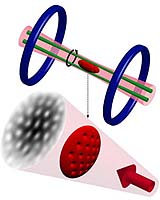
(In the top portion of this illustration, the gas of fermions (red) is trapped in an infrared laser beam (pink) and held in place by a magnetic field generated by current-carrying coils (blue). Two additional laser beams, shown in green, were used like coffee stirrers to set the gas into rotation. The result, as illustrated below, could be seen in a shadow picture of the expanded cloud that showed its superfluid behavior: The gas was pierced by a regular array of vortices. Image credit: Andre Schirotzek, MIT)

(The rotating superfluid gas of fermions is pierced with the vortices, which are like mini-tornadoes.
Image / Andre Schirotzek, MIT)


The work is based on the MIT group's earlier creation of Bose-Einstein condensates, a form of matter in which particles condense and act as one big wave. Albert Einstein predicted this phenomenon in 1925. Scientists later realized that Bose-Einstein condensation and superfluidity are intimately related.

Bose-Einstein condensation of pairs of fermions that were bound together loosely as molecules was observed in November 2003 by independent teams at the University of Colorado at Boulder, the University of Innsbruck in Austria and at MIT. However, observing Bose-Einstein condensation is not the same as observing superfluidity. Further studies were done by these groups and at the Ecole Normale Superieure in Paris, Duke University and Rice University, but evidence for superfluidity was ambiguous or indirect.

The superfluid Fermi gas created at MIT can also serve as an easily controllable model system to study properties of much denser forms of fermionic matter such as solid superconductors, neutron stars or the quark-gluon plasma that existed in the early universe.


Wednesday, October 12, 2011

Introduction To Quasicrystals


..Sulekha Rani,R , PGT Chemistry , KV NTPC Kayamkulam

Quasicrystals

In classical crystallography a crystal is defined as a threedimensional periodic arrangement of atoms with translational periodicity along its three principal axes. Thus it is possible to obtain an infinitely extended crystal structure by aligning building blocks called unit-cells until the space is filled up. Normal crystal structures can be described by one of the 230 space groups, which describe the rotational and translational symmetry elements present in the structure. Diffraction patterns of these normal crystals therefore show crystallographic point symmetries (belonging to one of the 11 Laue-groups). In 1984, however, Shechtman, Blech, Gratias & Cahn published a paper which marked the discovery of quasicrystals. They showed electron diffraction patterns of an Al-Mn alloy with sharp reflections and 10-fold symmetry. The whole set of diffraction patterns revealed an icosahedral symmetry of the reciprocal space. Since then many stable and meta-stable quasicrystals were found. These are often binary or ternary intermetallic alloys with aluminium as one of the constituents. The icosahedral quasicrystals form one group and the polygonal quasicrystals another (8,10,12-fold symmetry). We can state that quasicrystals are materials with perfect long-range order, but with no three-dimensional translational periodicity. The former is manifested in the occurrence of sharp diffraction spots and the latter in the presence of a non-crystallographic rotational symmetry.


File:Quasicrystal1.jpg
(Atomic model of an aluminum-palladium-manganese (Al-Pd-Mn) quasicrystal surface.)

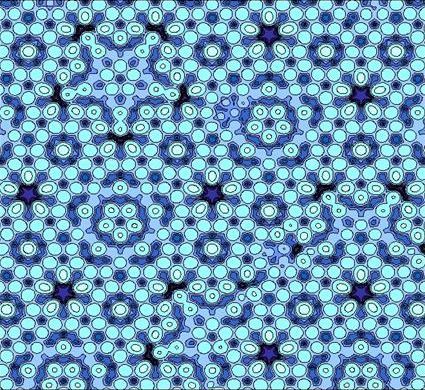
quasicrystal, is a structure that is ordered but not periodic. A quasicrystalline pattern can continuously fill all available space, but it lacks translational symmetry. While crystals, according to the classical crystallographic restriction theorem, can possess only two, three, four, and six-fold rotational symmetries, the Bragg diffraction pattern of quasicrystals shows sharp peaks with other symmetry orders, for instance five-fold

Types of Quasicrystals

quasiperiodic in two dimensions (polygonal or dihedral quasicrystals)

There is one periodic direction perpendicular to the quasiperodic layers.

  • octagonal quasicrystals with local 8-fold symmetry [primitive & body-centered lattices]
  • decagonal quasicrystals with local 10-fold symmetry [primitive lattice]
  • dodecagonal quasicrystals with local 12-fold symmetry [primitive lattice]

quasiperiodic in three dimensions, no periodic direction

  • icosahedral quasicrystals (axes:12x5-fold, 20x3-fold, 30x2-fold) [primitive, body-centered & face-centered lattices]

File:Ho-Mg-ZnQuasicrystal.jpg

(A Ho-Mg-Zn icosahedral quasicrystal formed as a dodecahedron, the dual of the icosahedron)


Regarding thermal stability, three types of quasicrystals are distinguished:

§ Stable quasicrystals grown by slow cooling or casting with subsequent annealing,

§ Metastable quasicrystals prepared by melt spinning, and

§ Metastable quasicrystals formed by the crystallization of the amorphous phase.


Except for the Al–Li–Cu system, all the stable quasicrystals are almost free of defects and disorder, as evidenced by x-ray and electron diffraction revealing peak widths as sharp as those of perfect crystals such as Si. Diffraction patterns exhibit fivefold, threefold, and twofold symmetries, and reflections are arranged quasiperiodically in three dimensions.

The origin of the stabilization mechanism is different for the stable and metastable quasicrystals. Nevertheless, there is a common feature observed in most quasicrystal-forming liquid alloys or their undercooled liquids: a local icosahedral order. The icosahedral order is in equilibrium in the liquid state for the stable quasicrystals, whereas the icosahedral order prevails in the undercooled liquid statefor the metastable quasicrystals.


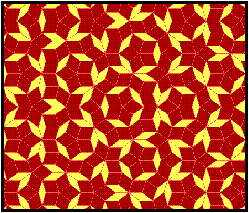
decorative tilings devised by medieval Islamic architects...A Penrose tiling

History...

Before quasicrystals were discovered in 1984 the british mathmatician Roger Penrose devised a way to cover a plane in a nonperiodic fashion using two different types of tiles. An example can be seen on the left. The tiles (rhombii) are arranged in a way that they obey certain matching rules. An equivalent tiling can be obtained for a 3D-arrangement. This is called a 3D-Penrose Tiling, which is made up of rhombohedrons instead of the rhombii. Such 2D and 3D-tilings have several important properties, such as the selfsimilarity, which means that any part of the tiling occurs again within a predictable area (or volume). After the discovery of quasicrystals in 1984 a close resemblance was noted between the icosahedral quasicrystal and the 3D-Penrose pattern. By putting atoms at the vertices of a 3D-Penrose pattern one can obtain a Fourier Transform which explains very well the diffraction patterns of the found Al-Mn quasicrystal. In a similar way one can use 2D-Penrose Tilings (left) to approximate a decagonal quasicrystal, which in a simple case consists of two layers with local 5-fold symmetry, which are rotated by 18 degrees so that the projection along the rotation axis gives a 10-fold symmetry. As stated above it is also possible to derive the vertices of such tilings using the nD-space approach (n>3). In this case we can obtain such a tiling by a projection of a nD periodic lattice (eg. hypercubic lattice).

In short, we can regard quasiperiodic tilings as frameworks that give quasicrystal structures when filled up with atoms in an appropriate way.

Diffreaction Pattern

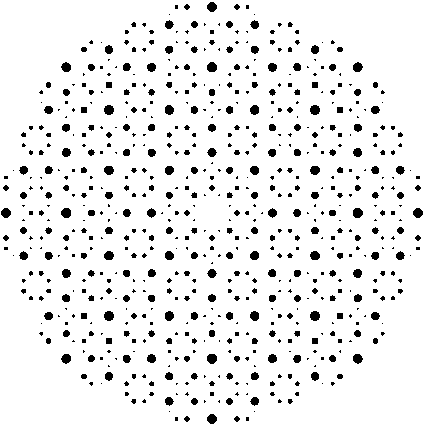
The symmetry that determines the type of the quasicrystal is first seen in its diffraction pattern. Below some simulations of diffraction patterns are shown, which could represent either electron diffraction patterns or the zeroth layers of precession photographs (X-ray):


Octagonal QC


Decagonal QC


dodecagonal QC


simulation for a Laue pattern (X-ray) from an icosahedral quasicrystal, whereby the x-ray beam is along one of the five-fold axes.


Materials Science of Quasicrystals

Since the original discovery of Dan Shechtman, hundreds of quasicrystals have been reported and confirmed. Undoubtedly, the quasicrystals are no longer a unique form of solid; they exist universally in many metallic alloys and some polymers. Quasicrystals are found most often in aluminium alloys (Al-Li-Cu, Al-Mn-Si, Al-Ni-Co, Al-Pd-Mn, Al-Cu-Fe, Al-Cu-V, etc.), but numerous other compositions are also known (Cd-Yb, Ti-Zr-Ni, Zn-Mg-Ho, Zn-Mg-Sc, In-Ag-Yb, Pd-U-Si, etc.)


Expermental Techniques

selected area electron diffraction
(SAED)
obtain reciprocal space information (symmetry, point group)
convergent beam electron diffraction (CBED)determination of the point group & space group
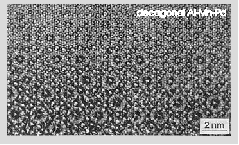
high resolution transmission electron microscopy
(HRTEM)
real structure information
(below decagonal Al-Mn-Pd)
X-ray diffraction techniques Film methods: Laue, Precession, Debye-Sherrer
Quantitative measurement: Powder diffractometer, Four-circle diffractometer
neutron diffraction obtain partial structure factors to assist structure refinement

Structure Solution Techniques

There are basically two different methods for solving the structure of quasicrystals. The first one is a 3D method, where information obtained from HRTEM images and known approximant structures is combined to obtain a realistic structure model.

The second one is the so-called nD structure analysis (n>3), where the structure is modeled in terms of the contents of the nD unit cells, i.e. the occupation domains. In contrast to the 3D method this is a quantitative analysis, which allows to calculate diffraction patterns and to refine a variety of parameters by the least-squares method. It therefore allows us to use all mathematical tools that have been applied in the analysis of conventional crystals, however, extended to the nD space. This technique may include the steps listed below, assuming the application of the nD-maximum entropy method as used by YAMAMOTO et al.

Step 1 - information on the three-dimensional structure
HRTEM images should be taken to obtain as much structural information as possible on the actual three-dimensional structure. For polygonal quasicrystals this means in particular the clarification of the cluster arrangement (in case there are basic clusters that form the whole structure). For icosahedral quasicrystals it is not possible as easily to determine cluster positions, since the high-resolution image shows only the projected structure along some direction. Information on the third spatial coordinate is therefore lost and possibly present clusters cannot accurately be associated with x, y and z-coordinates. The HRTEM images have a limited resolution in direct space so that the actual atom arrangement (distinction between atom species) within one cluster cannot be determined. Therefore an approximant structure can be helpful in giving a possible atom arrangement for some clusters, which can then be introduced into the structure model. An X-ray structure analysis for the approximant is in most cases straightforward and might even have been done before, so that already published data might be readily available.
This step 1 corresponds to the above mentioned first structure solution procedure.

Step 2 - location of occupation domains
The basis for the quasicrystal structure analysis is a single (quasi)crystal X-ray data set, usually taken on a four-circle diffractometer. (In future, however, imaging plate techniques might gain importance, since they allow rapid simultaneous measurements of many reflections including diffuse scattering intensities) The first thing to do with the measured X-ray data is to determine the exact location of the occupation domains. This can be done by using the nD Patterson method, which does not require any structure model, since only the square amplitudes of the structure factors go into the calculation.

Step 3 - nD starting model
The information from the first thwo steps is then combined to obtain a first rough nD structure model. This consists of a number of occupation domains at their determined locations. The occupation domains have to be constructed in such a way that by applying the section method the observed cluster arrangement is obtained, as well as the atomic decoration of the clusters as suggested by a known approximant structure.

Step 4 - MEM (maximum entropy method)
The starting model will then be refined, in order to obtain the phases of some strongest reflections, which is necessary for the MEM calculations. After performing the MEM calculations internal space MEM maps have to be plotted. These MEM maps provide information on the presence of possibly new (additional) occupation domains. Furthermore they show in more detail the size and shape of the occupation domains and the peak heights give hints on the distribution of transition metal atoms.

Step 5 - structure model modification
The information obtained from the MEM maps is then used for the modification of the nD structure model (i.e. the occupation domains). If necessary newly found ODs have to be constructed. The most difficult part is the distribution of atom species among the occupation domains. This is despite the findings in the MEM maps a trial and error procedure, due to the frequently occurring mixed occupancies. Key indicators for a structure model to be reasonable is the calculated point density and the calculated chemical composition.

Step 6 - refinement
The constructed structure model is then refined by means of the least-squares method. The necessity of further model modifications might arise so that steps 5 and 6 have to be repeated until a satisfactory structure solution is found. The refinement should include all necessary positional, occupational and thermal parameters.

Step 7 - structure plots
After obtaining the final structure model, several structure projections need to be drawn in order to elucidate the resulting structure. Since the section method provides all atom positions in x, y and z coordinates, individual clusters can be cut out (using suitable software, such as XRSV) and plotted separately, in order to show more clearly the local structure in the clusters.


System with Quasi Crystals
octagonal QC:

V-Ni-Si
Cr-Ni-Si
Mn-Si
Mn-Si-Al
Mn-Fe-Si

decagonal QC:

Al-TM (TM=Ir,Pd,Pt,Os,Ru,Rh,Mn,Fe,Co,Ni,Cr)
Al-Ni-Co *
Al-Cu-Mn
Al-Cu-Fe
Al-Cu-Ni
Al-Cu-Co *
Al-Cu-Co-Si *
Al-Mn-Pd *
V-Ni-Si
Cr-Ni

dodecagonal QC:

Cr-Ni
V-Ni
V-Ni-Si

icosahedral QC:

Al-Mn
Al-Mn-Si
Al-Li-Cu *
Al-Pd-Mn *
Al-Cu-Fe
Al-Mg-Zn
Zn-Mg-RE * (RE=La,Ce,Nd,Sm,Gd,Dy,Y)
Ti-TM (TM=Fe, Mn, Co, Ni)
Nb-Fe
V-Ni-Si
Pd-U-Si

* stable phases exist